The nudge to look again, clinical AI as told by a pathologist


Artificial intelligence is finding its way into hospitals, but not evenly. Some departments are further along than others. Pathology is one where the potential is already visible and, in some hospitals, already at work. The reasons are not hard to find: a growing volume of diagnoses, a shrinking pool of specialists, and a type of work that is well-suited to what AI does best.
Hugo Horlings is one of the pathologists working at that intersection every day. Based at the Netherlands Cancer Institute in Amsterdam, one of Europe's leading cancer centres, he spends his days analysing tissue samples, identifying cancer cells, and helping determine how patients should be treated.
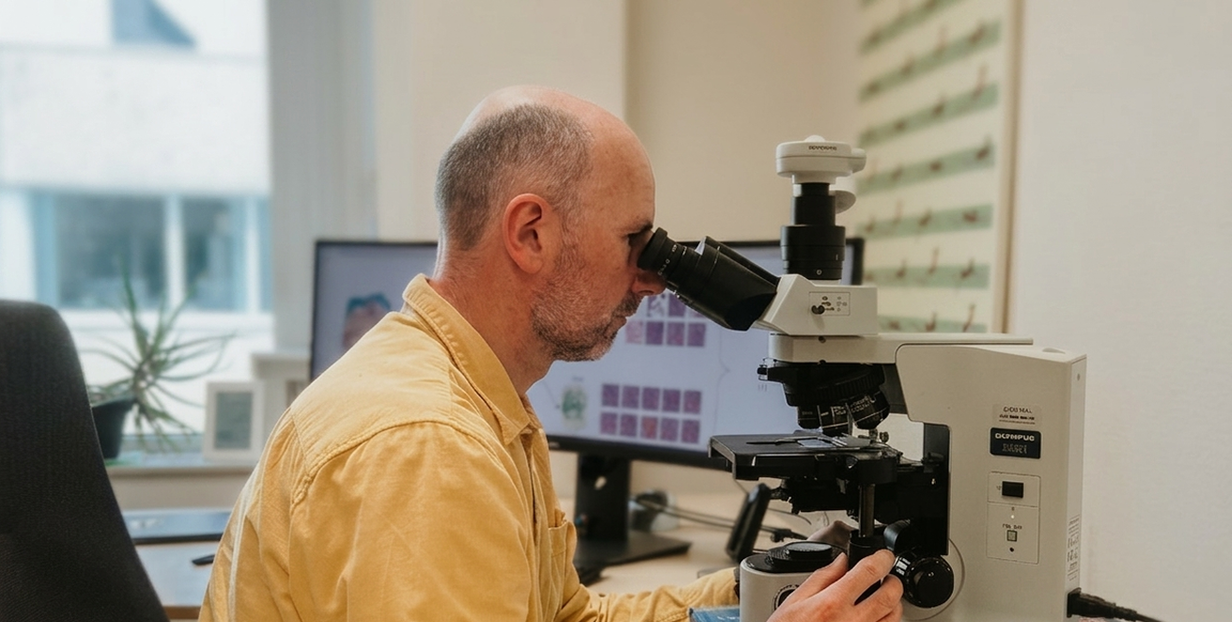
AI in the clinical setting: why it matters
Pathology is a clear-cut example of a highly precise and demanding job that requires expert judgement, yet there are fewer experts to do it.
A single biopsy contains roughly a million cells; pathologists can’t count them individually, nobody does, according to Hugo. 'First you do a first-eye sweep,' he says, 'and based on that you make an estimation.' This requires solid expert judgment, built over years. And the volume of work that demands it is growing.
To further sketch the situation, Hugo continues: “On top of that, the number of cancer diagnoses is rising, but the number of pathologists is not. At the time of this interview, in spring 2026, there were 22 open vacancies for pathologists in the Netherlands, a figure Hugo describes as the highest it has ever been.
"We have to do more work with the same or even fewer pathologists," Hugo says. And the same pressure is building across nursing and clinical support roles.
What AI actually does
In practice, we know that AI helps clinicians make better use of the time they have. In Hugo’s case: take a stack of 15 pathology slides. Today, a pathologist reviews each one. With AI pre-screening those slides and flagging the ones that require closer attention, that same pathologist might only need to closely examine two or three.
They still see every slide. They still make every call. But their focus goes where it’s most needed.
But beyond speed, AI is beginning to do something noteworthy. It sees things differently. A pathologist looking at a tissue sample immediately takes in a million cells, making pattern-based judgments built on years of training. AI can count every single one of those cells and then ask questions a human eye simply can’t answer at scale. Are these immune cells clustered near the tumour? Are they touching it? Where exactly are they located? That kind of spatial detail, Hugo explains, is opening new territory entirely:
“An AI model can count those immune cells reliably and quickly. More than that, it can map where they sit.”
This is particularly important for Hugo and his team. They study immune cells that gather near tumours as part of the body's natural defences, known as tumour-infiltrating lymphocytes1. In earlier research2, he and his colleague, Marleen Kok and team, focused on a specific type of breast cancer: small triple-negative tumours, which are typically treated with chemotherapy. What they found was unexpected. Patients with a high density of these immune cells had survival rates equivalent to those of patients without cancer, even 15 years after diagnosis2.
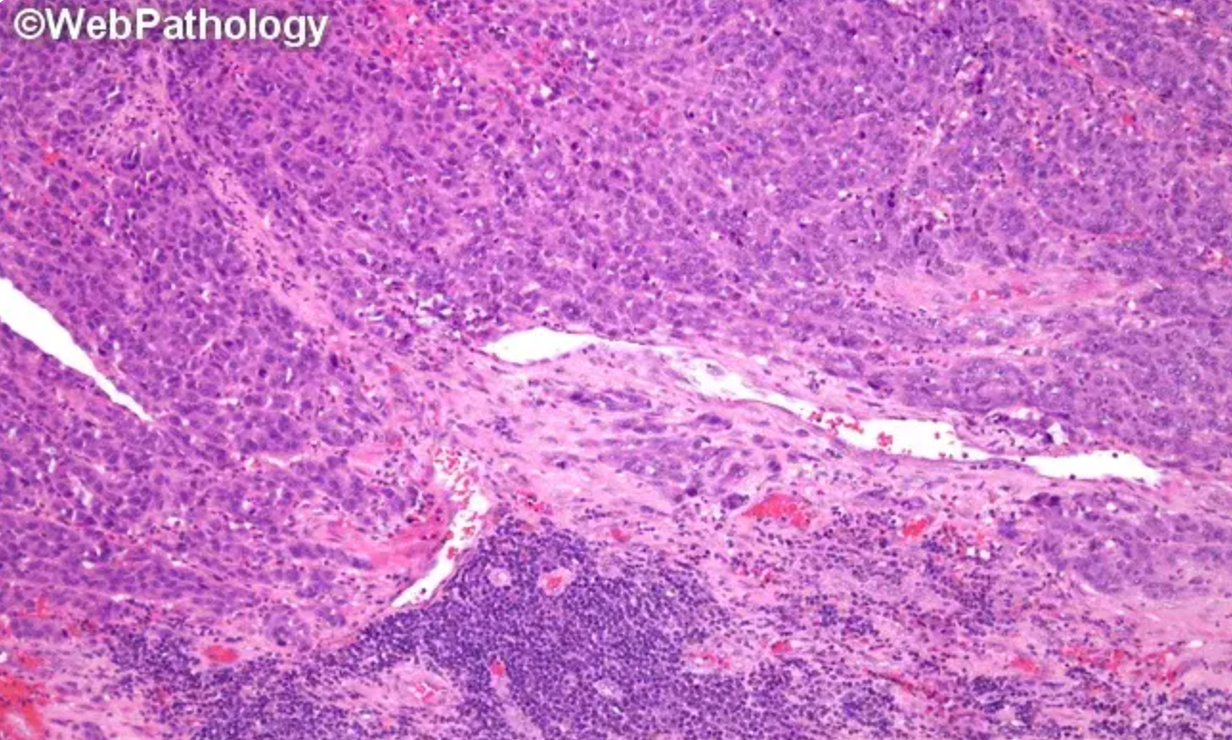
Example of a tissue sample showing tumour-infiltrating lymphocytes (TILs) under the microscope. The small, dark cells are the immune cells Hugo's team studies. Example from WebPathology 4
The implication is significant. For some of these patients, chemotherapy may not be necessary at all, sparing them treatments with serious side effects they do not need. Whether that is indeed the case is now being investigated in the OPTImaL Trial1,3, supported by the Netherlands Cancer Institute.
While this clinical insight exists without AI, the challenge is making it usable at scale. Across the Netherlands, 450 pathologists were needed to consistently identify and count these immune cells. Manually, that is slow and variable. With AI, it becomes tractable, according to Hugo:
“You can now ask the computer: where are these cells localized? How many of them are touching a tumour cell? Spatial information is reaching the next level, something we cannot see or count with our human eyes.”
AI and what it means for the role of the clinician
There’s a version of the AI conversation in healthcare that sounds like science fiction: autonomous systems making diagnoses, algorithms replacing specialists, machines doing the work of doctors. Hugo is quick to set that aside.
“I really see AI as an assistant.”
Under the EU AI Act, fully autonomous AI decision-making in clinical settings isn’t permitted, and Hugo agrees that this is appropriate. These models are still developing, and we’re still learning how to work with them. The human stays in the loop, and Hugo emphasizes that it should not only be the case because it is a regulatory formality, but more so because good medical practice demands it.
The patient who changes their mind. The family situation that shifts the calculation. The preference that exists nowhere in any record. No system captures that.
“There are far more nuances than a computer can foresee. The decision always stays with the human; keeping the human in the loop is how responsible AI in medicine works”
‘From will it replace me’ to ‘what will it save me’
A few years ago, the dominant fear Hugo heard from colleagues was straightforward: will AI replace me? He does not hear that much anymore, the conversation has moved.
"Now it is more: what will it actually save me? And the answer is quite a lot of time."
For many clinicians who have started experimenting, the answer turns out to be significant. Quite a lot of time, it turns out.
According to Hugo, there is a subtler change worth paying attention to:
“AI does not just take tasks off a clinician's plate. It sometimes nudges you to look again. When a system flags something unexpected or surfaces a possibility, you had not considered, you check it and think again.”
Hugo compares this to the introduction of structured checklists in aviation. Plane crashes dropped significantly when pilots started using them. Surgeons adopted the same approach in operating rooms, confirming before and after every procedure that nothing had been missed, and complications decreased. The checklist did not replace expertise; it caught what expertise, under pressure, sometimes misses.
Hugo thinks AI could work similarly for diagnosis. A prompt to check again. A flag on something you might have moved past. Less room for one pathologist to give an estimation of five percent and another to say ten.
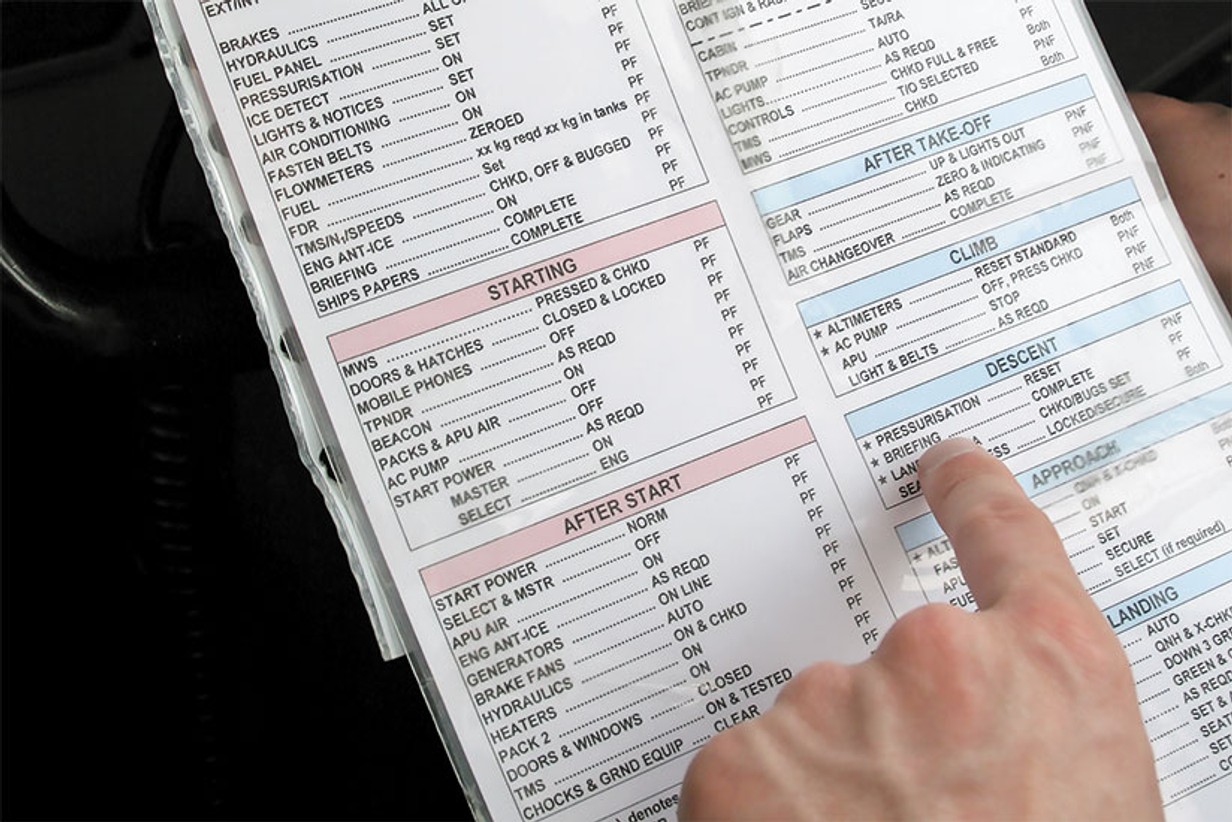
Example of an aviation checklist, from the Flight Safety Foundation 5
Sharing is multiplying
Near the end of the conversation, Hugo reaches for something his father always says. When you share something, you multiply. And this also accounts for knowledge.
He applies it to what he sees as the only viable path forward. Hospitals cannot do this alone. They do not have the technical capacity, the legal infrastructure, or the bandwidth. Technology companies cannot do it alone either. They do not have the domain knowledge, the clinical understanding, or the trust that comes from years inside a department.
“Bring that together,” he says, “and you get something truly valuable.” It is a simple idea. But in a field where hospitals and technology companies have spent years talking past each other, it is also the hardest thing to get right. For those ready to take a first step, his advice is characteristically direct: start small, expect the decisions to multiply rather than disappear, and do not try to build it alone.
Hugo Horlings has spent years looking at things too small for the human eye to see clearly. He is also someone who thinks the most important next step in medicine is not a better algorithm. It is a better relationship between the people who build the tools and the people who use them.
Hugo hopes this conversation multiplies. For those already working with AI, or just thinking about getting started, he shared a few things he has learned from doing it every day.
Start small:
Don't look for the grand application. Find the most frustrating part in your daily workflow and bring it to AI first. And before trying anything clinical, start at home. A subscription to one of the large language models, ChatGPT, Claude, or Gemini, is enough to begin.
Becoming a more effective decision-maker:
Here is something that does not get said enough about AI in clinical practice: it does not reduce the number of decisions you make; it changes what those decisions are. AI handles the searching, the summarising, the reconstruction of fragmented records. What that frees up is not purely about reducing work. It is about freeing up space for the work that matters most. You move from information gatherer to full-time decision-maker, and that shift takes getting used to.
Prompt with precision:
Vague prompts produce vague answers. Give the model a role and a context: instead of asking a broad question, tell it who it is and what you need. Ask it to verify its own output before giving you the answer. And if you want something in a specific format, paste in a blank template or a fully anonymised example. The model will follow the structure.
Don't build alone:
This applies to individual clinicians and to hospitals. Neither can do it well in isolation. The results come from working alongside people with complementary knowledge, whether that is a technically-minded colleague or an external partner that can help build the right solutions and infrastructure. One of those examples is kaiko, built specifically for clinical environments and already live at the Netherlands Cancer Institute.
Our systems are currently developed and tested in research and validation settings. Some of our products focus on supporting administrative and workflow processes and are not medical devices. Any future clinical decision support use would be subject to regulatory approval and compliance with applicable medical device frameworks, including the EU Medical Device Regulation (MDR).